For surfers, access to data has never been the problem. Wave height, period, wind and tides are all readily available, often in overwhelming detail. The real challenge is making a confident call; deciding whether the conditions justify the early wake-up, drive and paddle out. Through a product marketing lens, this gap between raw information and action reveals why Surfline has become far more than a forecasting tool.
This piece explores how Surfline applies product marketing principles to translate surf data into confidence through its value proposition, product design and user experience.
Making sense of surf data
On its own, surf data such as wave height, period and tides is abstract. Although the numbers are technically accurate, they don’t answer the question most surfers are actually asking, “Is it worth surfing right now?”

For example, a forecast for my local break may tell me that it is 1.5m of swell at 10 seconds with a light offshore wind. For me and many others, this signals a clear opportunity to get in the water. But for many others, it creates a sense of hesitation. “Are these good conditions?” “Will it be worth the early wake-up?”
This gap between information and action is a key element of Surfline’s value proposition.
Surfers don’t just want raw data. They want to know what this means for them at their specific break, at a specific point in time. As such, the raw data requires interpretation, local knowledge and experience – and this is where Surfline comes to the rescue.
It recognised that its real competitors weren’t other forecast sites (because this will always be a factor), but it was indecision. By translating complex data into clear, digestible signals, Surfline shifted its value from merely information to confidence and trust.
Surfline’s value proposition
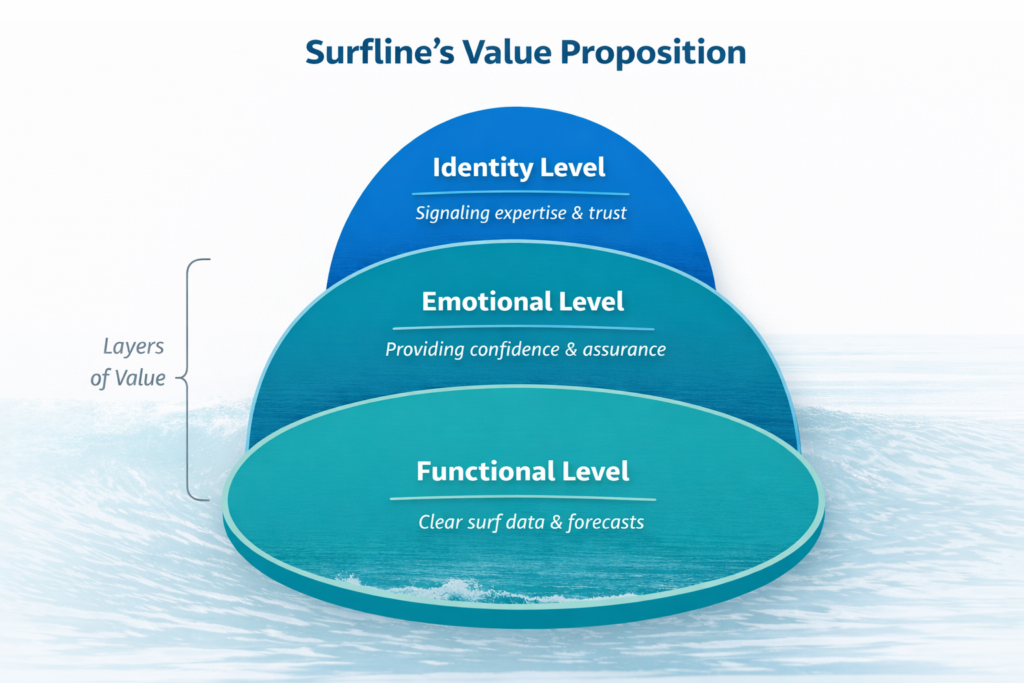
Surfline’s value proposition extends far beyond forecasting accuracy. In fact, it functions across three key layers; functional, emotional and identity. At a functional level, it translates highly technical ocean data into a clear rating system with summaries and visuals that avoid confusion.
At an emotional level, Surfline reduces uncertainty. Rather than worry, “Should I go?”, it helps surfers feel assured in their decisions before committing excessive time and energy.
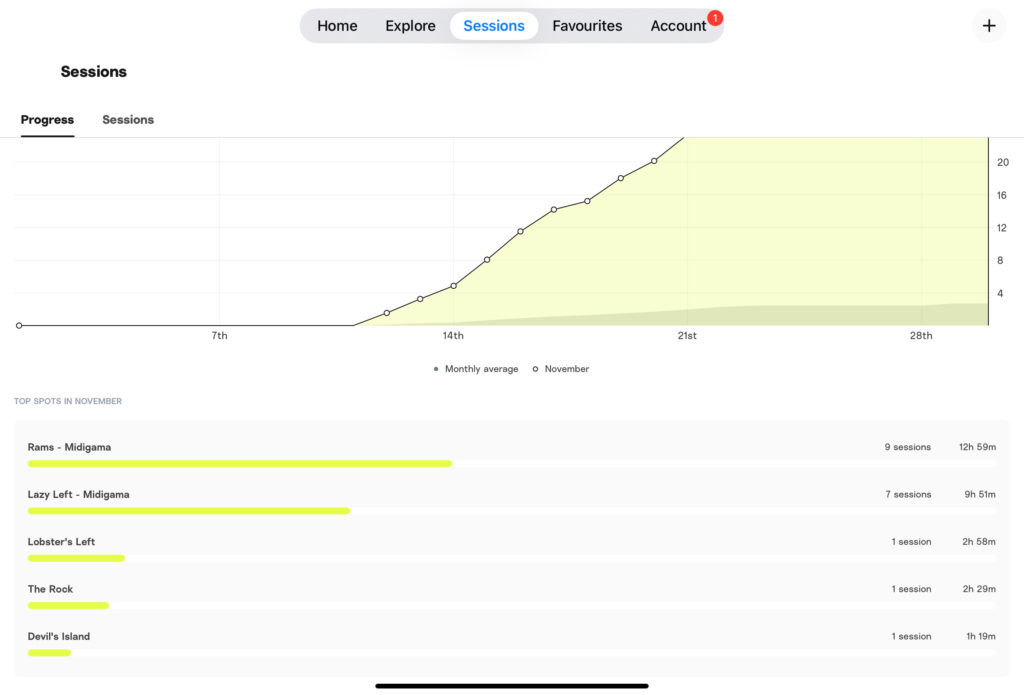
Meanwhile, at an identity level, using Surfline signals that you’re informed and competent. Through its features like spot ratings, surfers can tie their decision-making to a trusted signal. Over time, by making “good calls”, this feature reinforces confidence in one’s own judgement. Their session analytics feature ensures surfers can review their metrics. This helps to instil a sense of consideration towards personal development.
Surfline’s “segmentation”
Surfline doesn’t ask surfers to define their level. Instead, it naturally adapts its product to suit the user’s level of engagement.
For casual surfers, the experience is simple and intuitive with spot ratings, live cams and short summaries. As commitment deepens, the product reveals additional functionality. Longer-range forecasts, regional insights and additional features support surfers planning trips or chasing specific conditions.
At the most engaged end, Surfline offers precision. Advanced charts, metrics and session analytics allow surfers to fine-tune their decision-making and measure progression. The beauty is that the platform progressively reveals its value, rewarding the curiosity of users.
From a product marketing perspective, the layered approach is intentional. Without fragmenting the experience, Surfline strategically aligns messaging and feature visibility to different levels of surf maturity. In doing this, the barrier of entry is decreased and a clear path to deeper adoption and long-term loyalty is formed.
Website UX as a product marketing lever
Surfline’s product marketing doesn’t stop at the app; it’s reinforced consistently across all its platforms. On its website, this comes through the form of intentional UX decisions that shape how users discover, understand and adopt the product.
From the moment users land on Surfline’s website, the product’s core value is immediately clear. High-quality surf cams from iconic breaks dominate the hero area of the homepage. This communicates Surfline’s primary utility without any explanation needed.
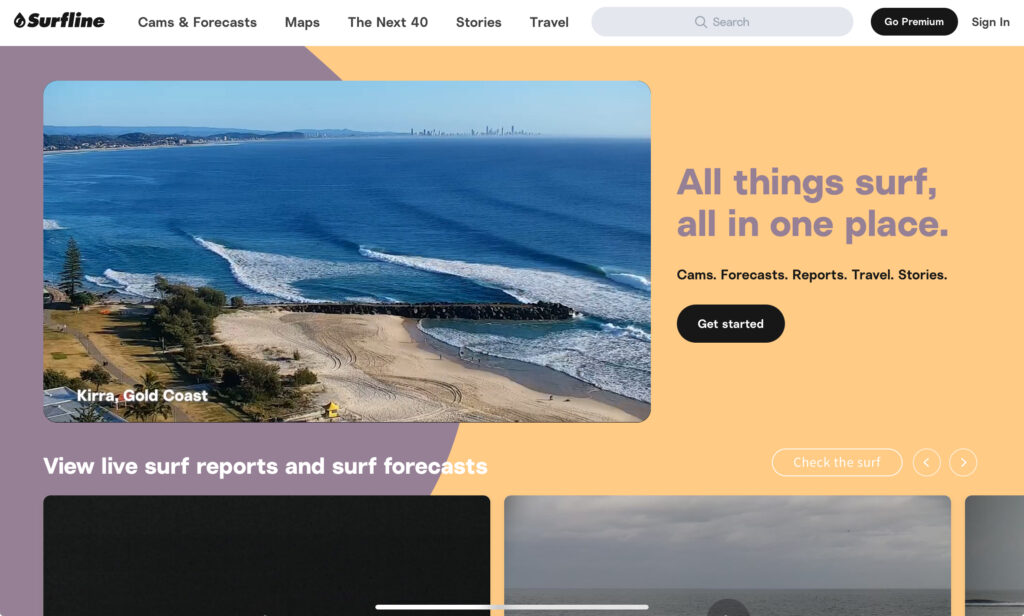
Below the fold, the homepage highlights Surfline forecasts and editorial content through a Stories carousel module. Importantly, the homepage stops here, resisting the urge to overpopulate the page.
The primary menu clearly surfaces Surfline’s key offering. Cams & Forecasts and Maps reveal product value, while The Next 40 and Stories support brand narrative and education. Travel extends that value into surf planning.
Usability continues within the dropdown navigation. Both Cams & Forecasts and Maps expand into logically grouped options such as Mult-Cam, All Surf Spots, Wave Buoys and Charts. This suggests a navigation menu refined over time through user behaviour and search intent, helping to improve feature discoverability and reduce friction.
Pages like The Next 40 and Travel deepen trust and value. The Next 40 opens with an engaging video before transitioning into longer-form storytelling from CEO Ross Garrett, reinforcing Surfline’s legacy, environmental commitment and future focus. Travel adds locally informed surf guides that extend product value, strategically pairing evergreen content with premium, paywalled seasonal insights.

Finally, the Stories hub acts as a content-led product marketing engine. It reinforces Surfline’s authority, supports SEO-driven discovery and keeps users engaged when conditions aren’t favourable, helping to extend the product’s relevance beyond live forecasting. Articles are internally linked, easy to reshare and supported by related content, encouraging deeper exploration. From a product marketing perspective, the site doesn’t just host information, it actively supports discovery, authority and ongoing engagement.
As a surfer, it’s easy to take Surfline for granted. But viewed through a product marketing lens, it’s clear how intentionally the product is designed to reduce friction, build confidence and support progression at every level. From forecasts to storytelling, Surfline consistently reinforces its value by understanding not just what surfers need, but how they think and decide.